


 Have you ever wondered how many people earn a particular hourly wage in the United States? Or how many people there are between two hourly wages? For instance, just how many people are there who are paid at a rate between the current U.S. minimum wage of $5.15 per hour and the newly proposed $7.25 per hour?
To find out, we started with the most recent Current Population Survey data available from the Bureau of Labor Statistics (from 2005). From this source, we learned that there are 75,609,000 workers in the U.S. who are paid wages or salaries at an hourly rate (or 60.2% of the total U.S. workforce of 125+ million in 2005.) We also learned that 479,000 people are paid the minimum wage and that 1,403,000 people on average earn less than the current minimum wage level of $5.15.
Then, we went to a December 2006 report from the Congressional Budget Office that provided hourly wage data by percentile. For example, we learned from this document that 10% of hourly wage earners make $7.44 or less, 20% make $9.07 or less, and that 90% make $33.45 or less! What's more, we found out that the median wage earned by hourly wage earners is $14.82.
So, what can we do with these figures? Well, if we take all the values we found related to the distribution of hourly wages paid in the U.S., we can use ZunZun's online curve-fitting application to create a curve to fit our available data, and use that formula to estimate how many people there between any two given hourly wages!
So that's what we did! We recognized the basic data as having an "S" shape, so we opted to model the data using a Gompertz type distribution. Our modeled curve is below (x represents wages per hour and y represents the percentage of the hourly work force):

As you can see, the curve is pretty darn accurate for values between the 10% and 90% percentiles (on the y-axis), and generally reflects the trend revealed by our selected data points. Math fans will recognize that the basic formula for this kind of curve is:
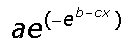
ZunZun provided the values for a (0.93185), b (1.88835) and c (0.15855) in the equation above while e is a mathematical constant. Now, the curve shown above reveals this formula will seriously overestimate the number of workers at the low end of the scale and will underestimate the number of workers at the high end. Because it's of special interest right now, we've created a special formula for handling the low end of the scale, between 0 and 15% of the hourly wage workforce, that covers the range of workers for whom the new minimum wage increase proposals would affect. The formula we've used to represent the distribution of wage earners in this range is:

As before, x represents an hourly wage, and y represents the percentage of the hourly wage earning workforce that earns the hourly wage x. Our tool below does all this math, estimating the percentage and number of workers fairly well between any two hourly wage levels from 0 to 90% of workers paid wages or salaries at an hourly rate:
Now, for the sake of comparing the results of the estimated hourly wage earner distribution tool above and actual data, here are some select values of the actual distribution at the low end of the scale:
| Selected 2005 Hourly Wage Workforce Distributions | ||
|---|---|---|
| Range of Hourly Rates | Number Paid in Range of Hourly Rates | Percentage Paid in Range of Hourly Rates |
| 0 - 5.14 | 1,403,000 | 1.86% |
| 0 - 5.15 | 1,882,000 | 2.49% |
| 5.15 - 7.44 | 5,678,900 | 7.51% |
The tool doesn't perfectly match the known hourly wage earner distribution for 2005, but should be good enough to provide data for use in other calculations!
Previously on Political Calculations
- The Disappearing Minimum Wage Worker
- Back in 1980, roughly 8.9% of the total U.S. workforce earned the minimum wage or less. Today, that figure is 1.5% of the total U.S. workforce (and less than 2.5% of the hourly wage earning workforce!) The minimum wage worker is a vanishing breed!
- Jobs and the Minimum Wage
- Our short look at who really benefits and who really hurts when minimum wage levels are set.
- The Minimum Wage and Small Business
- What if you were a small business owner whose employees include a good percentage of minimum wage workers? What would a change in the minimum wage mean for your business?

 :.
:.

0 comments:
Post a Comment